Showing posts with label Molecule hunting. Show all posts

Wednesday, 18 June 2014

A Little TLC

Now that we have collected our different fractions, it is time to begin to consider what may be in the different fractions and, in particular, whether there is potentially a new and exciting molecule in one of them.

The first step towards doing this involves a process called thin layer chromatography (TLC).  Before carrying out TLC each fraction is redissolved in a small volume of 'Magic Brew' (a mixture of methanol and dichloromethane).

In TLC a capillary tube is used to add small amounts of each sample onto a TLC plate.  A TLC plate is a thin piece of plastic covered in silica.  The plate has a horizontal line near the bottom and you place a labelled pencil mark where you want each sample to go on the line.  The aim is to get a nice small circle of sample on each location.  To achieve this you 'spot' a small amount of sample, let it dry, and then add some more sample.  (If you put too much sample on at the start it spreads out too far and you will not get good results.)

Once we have spotted all our samples onto the plate, the plate gets lowered into a glass container with a small amount of solvent in the bottom.  The solvent used was 5% methanol in dichloromethane.  A lid is placed on the container so that fumes from the solvent are kept in the container.

The solvent begins to rise up the plate and as it does so it carries molecules with it. The surface of the TLC plate is quite polar. This results in polar molecules sticking to the plate while molecules of lower polarity continue to travel up the plate with the solvent. You end up with the most polar molecules at the bottom of the plate and the least polar molecules at the top.


The plate to the right shows my three P. microcladioides fractions. The 100% fraction contains a number of coloured compounds which have traveled varying distances up the plate.  There appear to be no compounds in the 30% and 75% fractions but this this only because none of them are coloured.  To see more compounds the plate is put under 2 different wavelengths of UV light.

The image to the left shows the plate when placed under a 350 nm UV light source while the image on the right is of the plate under a 254 nm UV light source. As you can see, new spots have shown up on the plate.  These are for molecules that contain chromophores. A chromophore is a part of a molecule that absorbs certain wavelengths of UV or visible light and reflects other wavelengths. (Chromophores often contain alternating single and double bonds.)

You may notice that the spots for the 30% fraction are all fairly low.  This makes sense as you will recall that the molecules in the 30% fraction are the most polar ones and it is these polar molecules that stick to the relatively polar surface of the plate and therefore don't travel very far.

Tuesday, 3 June 2014

Drying Down

Once we have obtained a number of solutions containing groups of molecules extracted from our red algae, it is time to dry down those solutions.  This involves evaporating off the solvent so that solid compounds remain.  To do this we use a rotary evaporator.

A rotary evaporator works by spinning the solution in a round-bottomed flask. The solution is spread around the inside surface of the flask and this increases the surface area from which the solvent can evaporate.

The rotary evaporator is attached to a pump which removes some of the air from inside the evaporator and therefore creates a partial vacuum. As the gas pressure above the surface of the solution is decreased, the solvent will evaporate off more quickly than it would under normal pressure.

The rotary evaporator to the left has a cold finger. This is the cone shaped object you can see inside the top part of the evaporator.  This is made very cold by filling it with dry ice (by removing the yellow lid at the top).  Solvent gas that has evaporated from the solution condenses into liquid when it comes into contact with the cold finger.  The liquid then drips into the flask at the bottom of the condenser.

As the solvent evaporates from the flask, the flask begins to get very cold and ice may even begin to form on the outside of it.  This is because when liquids evaporate they take heat from their surroundings.  If the flask gets too cold it will slow down the rate at which the solvent evaporates.  To get around this, the flask can be lowered into a water bath which prevents the flask from getting too cold.

On of the tricky things about drying down solutions is that they sometimes become unstable (particularly if they contain a mixture of water and acetone).  This can result in them bumping and spurting material up towards the condenser.  This would be a problem as we would be losing precious material and also contaminating the rotary evaporator.  For this reason, there is a glass trap above the round-bottomed flask. (It is between the red and green clips in the picture.)  Material that spurts gets caught in the trap and can be retrieved from there.


Once the solution has been dried down, you are left with a mixture of solid compounds attached to the the inside of the flask.  As the flask would be bulky to store (and we want to free it up so we can use it again), the next step is to transfer the compounds into a small glass vial. Before doing this we use a balance to find the mass of the vial so that we can later calculate the mass of material in the vial.


To transfer the material we need to redissolve it.  In the lab we use a solvent referred to as Magic Brew.  It is called this as it will dissolve most molecular compounds.  Magic Brew is a mixture of methanol and dichloromethane.  A small amount of Magic Brew is added to the flask in order to redissolve the solid compounds.  A glass pipette is then used to transfer the solution into the glass vial. The solution then needs to be dried down again on the rotary evaporator.  

The final step is to remove any traces of water that may not have evaporated on the rotary evaporator (as water has a higher enthalpy of vaporisation than most of the organic solvents we are using).  Any water needs to first be frozen and this is done by rolling the flask in liquid nitrogen.  The flask is then attached to a freeze dryer. As with the rotary evaporator, a freeze dryer creates a partial vacuum. This causes the frozen water to sublime (turn straight into  gas).  The water vapour is continually removed from the system by the freezer component of the freeze dryer.

Finally, the vial is reweighed and then stored in the fridge until we next want to work on the sample.

Thursday, 22 May 2014

In the Dark

When working on solutions and separating molecules into fractions (groups of molecules) we want to try and ensure that none of the molecules break down and become something else.  For example, some molecules are light sensitive and can break down in the presence of too much light.  For this reason we try and keep solutions, and columns with molecules loaded onto them, in the dark when we are not working on them.

Solutions in small conical flasks, or dried down fractions in vials, are kept in a fridge.  Not only is it dark in the fridge (yes the light does go off when you shut the door), but it is also cold.  As you know, reactions happen at a much slower rate at low temperatures, so any potential reactions that could occur will hopefully be slowed right down.

Larger conical flasks containing solutions are kept in a dark cupboard.

Sometimes when large volumes of solution are being passed through a column, the column is left to run for quite a long period of time.  To keep light out the whole apparatus is wrapped in tinfoil.

Tuesday, 6 May 2014

Back-Loading

We now have three solutions containing dissolved molecules - the 30% fraction containing fairly polar molecules, the 75% fraction containing slightly polar molecules and the 100% fraction containing molecules of very low polarity.  The next step is to remove the water from these solutions so that we can obtain the dissolved compounds.  This will be done using a rotary evaporator.  This process will involve removing some of the air above the solution to create a partial vacuum. With the 30% and 75% fractions this is going to cause a problem as mixtures of water and acetone are unstable under those conditions and will tend to jump and spurt as we try to dry them down.  To get around this we need to first use a process called back-loading.

Back-loading a fraction involves reloading it onto a HP20 column. To encourage molecules back onto the non-polar column, the volume of the solution is doubled by adding water, thus making the solvent more polar. For example, my 75% fraction of P. microcladioides had a volume of 240 mL so I added 240 mL of water to it before passing it through the HP20 column.  This caused many of the molecules of low polarity to attach to the column.

In the photo to the right my 75% fraction of P. angustum is being back-loaded onto the left-hand column while my 75% fraction of  P. microcladioides  is being back-loaded onto the right-hand column.

Once the solution has passed through the column, the solvent is made still more polar by again doubling its volume by adding water.  So I added a further 480 mL of water to my 75% fraction of P. microcladioides.  It is then passed through the column again and the moderately polar molecules will now attach to the column.

As the volumes become larger, passing the solution through the column can become very time consuming.  You also have to watch out for compounds beginning to crash out of solution. This can happen when you are adding water and the solution becomes too polar for some of the compounds to remain dissolved. These compounds then begin to precipitate out of solution.  As soon as you see this begin to happen you need to stop adding water and start passing the solution through the column.

The picture to the left shows my 75% fraction of P. angustum part way through the back-loading process.  You can see that some orange coloured compounds have made their way to the bottom of the column while some green coloured compounds have attached further up.  While the coloured compounds are the interesting ones to look at, many of the compounds will actually be colourless.

Once the molecules have been back-loaded onto the column they are then removed by passing acetone through the column. The eluate collected contains the molecules and the solution can now be dried down on the rotary evaporator as the solvent is acetone rather than a mixture of acetone and water.

Tuesday, 1 April 2014

Elution

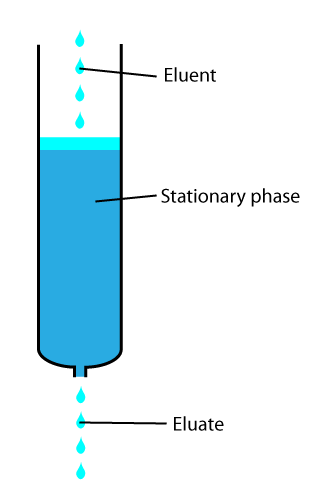
After cyclic loading molecules onto a HP20 column, the next step is to get them off again in groups of molecules with similar polarity.  We do this by passing solvents of different polarity through the column. Molecules on the column with similar polarity to that of the solvent will dissolve into the solvent and be carried out of the column and into a conical flask.  This process is called elution.   The solvent that passes through the column is the eluent. Once it emerges from the column containing dissolved molecules it is referred to as the eluate.

The first solvent used is water.  As water is quite polar and there should be few if any significantly polar molecules on the column, very little material should be removed by the water.  Its role is really just to rinse the column of any salts or very polar molecules that may have become attached.

The next solvent used is 30% acetone (30% acteone / 70% water by volume). This solvent is less polar than water and will remove moderately polar molecules from the column.  The eluate is collected in a conical flask.

Then it is the turn of 75% acetone (75% acetone / 25% water by volume). This removes a group of less polar molecules.

Finally 100% acetone gets passed through the column and removes molecules of very low polarity (and non-polar molecules).

We refer to the solutions gained as the 30% fraction, 75% fraction and 100% fraction.  Each fraction will contain a range of molecules that still need to undergo further sorting.


Friday, 14 March 2014

Cyclic Loading

Right, back to the business of hunting for undiscovered molecules in our red algae (seaweed).  You may remember that we have got as far as extracting a whole range of molecules which are now sitting in solution in a conical flask.  The next step is to start separating the molecules into groups.  To do this we are going to use the varying polarities of different molecules.

In class we have looked at covalent bonds having different degrees of polarity depending on the difference in electronegativity of the two atoms involved in the bond.  Some bonds are not polar at all (non-polar) while others may be only slightly polar or very polar.  We have tended to classify molecules as either non-polar or polar and left it at that. However molecules also have varying degrees of polarity.  For example, water is more polar than methanol which is more polar than acetone.  We are going to use the relative polarities of these three solvents to help us to separate our mixture of molecules.

To begin with the second extract is passed through a column filled with 'HP20'.  HP20 is comprised of small white beads of polystyrene divinylbenene.  These beads provide a very non-polar surface that molecules can attach themselves to. Molecules will do this if their polarity is closer to that of the HP20 than it is to the polarity of the solvent they are in. So molecules in the mixture that have a low polarity will come out of the moderately polar methanol solvent and attach themselves to the HP20.

Solution that passes through the column is collected in a conical flask at the bottom.  The flow rate is about one drop per second so it can be quite a slow process.  Once the second extract has passed through the column, it is the turn of the first extract which is loaded into the top of the column. Eventually both extracts have passed through the column and the solution containing all the molecules that have not attached to the column is in the conical flask at the bottom.

We now want to encourage some of the slightly more polar molecules onto the column.  To do this we need to make the solvent more polar.  This is achieved by doubling the volume of the solution by adding distilled water.  Remember that water is more polar than methanol so the solvent (now a mixture of water and methanol) is more polar than it was before. The solution is put through the column again and this time some of the slightly more polar molecules attach to the column.  This process is repeated one more time to make the solvent even more polar and to cause more molecules to attach to the column.

Molecules of high polarity will not, of course, attach to the column as they will prefer to remain in the polar solvent.  This is not a problem for us as the molecules that we are hunting for do not tend to be of high polarity.  However, just in case something important is still in the solution, we will keep it in the meantime.

Monday, 24 February 2014

Extracting Molecules

After sitting in methanol for 24 hours, it was time to separate the algae from the solution.  To do this I used a Buchner flask and funnel. The flask is attached to a simple pump that lowers the pressure inside the flask and helps to pull solution through the filter paper in the funnel.  I tipped the solution into the funnel and then added the algae so as to retrieve as much solution as possible.  The solution (with the extracted molecules) ended up in the flask while the algae was trapped in the funnel.  The solution is called the first extract.

The algae was then returned to its original flask and more methanol was added to it (300 mL for the P. angustum, 500 mL for the P. microcladioides).  It was then left for another 24 hours so that more molecules could be extracted from the algae.

After 24 hours the algae was separated from the solution in the same way as above. The solution obtained this time is called the second extract.

We have now probably finished with the algae, but rather than throwing it out, the algae is placed in a bag and stored in a freezer.  This is so that it is still available in case we need to use it again later.


Thursday, 20 February 2014

Meet the Algae

My molecule hunting exploits are going to be based on two species of red algae - Plocamium angustum (to the right) and Plocamium microcladioides (to the left).  These are both types of seaweed found in New Zealand waters.  They contain chloroplasts as they produce food by photosynthesis.  The red colour is due to  pigments in the algae.

My first task is to extract a mixture of molecules from the algae.  This done by chopping a sample of the algae into small pieces, putting the pieces into a conical flask and then covering them with methanol.  The methanol acts as a solvent which molecules from the algae dissolve into.

I used 48.1 g of P. angustum and needed 300 mL of methanol to cover it.  The P. microcladioides was a larger sample.  It had a mass of 97.8 g and required 500 mL of methanol to cover it.

The conical flasks were then covered in aluminium foil and put into a dark cupboard.  Why? Some of the molecules being extracted could be light-sensitive - they might break down into something else if exposed to too much light.  The flasks were left overnight.

Almost immediately the methanol started turning green (not red!).  The green colour is probably due to chlorophyll from the chloroplasts in the algae.

You may notice that the flask has a code written on it. 'BPM1' refers to my 1st lab book - my initials are BPM. (If you look carefully you will see that I accidentally left the '1' off). '01A' means that it contains sample A (my P. angustum) and information about it can be found on page 01 of my lab book. Our lab books have pre-numbered pages and also produce a carbon copy of each page.  The lab books stay in the lab so anybody can check what is in a flask by going to the relevant lab book.  They also provide a permanent record of all practical work undertaken in the lab.

Out of the Classroom

I can usually be found at Paraparaumu College where I get to teach lots of great students about science and chemistry. However, for the first half of this year I wont be at Paraparaumu College, but instead I am based in the School of Chemical and Physical Sciences at Victoria University of Wellington. I am here on an Endeavour Fellowship which is administered by the Royal Society of New Zealand.  Along with about 20 other primary and secondary school teachers from around the country I have been given the opportunity to step outside the classroom, roll up my sleeves and experience working with scientists on real science challenges.  It is a great opportunity for me to learn more about how scientists create new scientific knowledge and to expand my own chemical knowledge, skills and experiences.

I am working in a marine natural products lab under the supervision of Dr Rob Keyzers and Associate Professor Peter Northcote.  With me in the lab are several PhD and post-doctoral (have already got their PhD) students who are hunting for undiscovered molecules in things that live in the sea such as sponges and seaweed.  Why are they doing this?  Some of the molecules that are discovered may prove to have uses that are beneficial to people.  For example, a molecular compound may be effective at killing certain types of bacteria and could therefore potentially be used as an antibiotic.  Even for molecules that don't prove to have any immediate use, by discovering them and working out their structure, the chemists in the lab are adding to the global chemistry community's collective knowledge.  Other chemists in other parts of the world can make use of that knowledge as they undertake their own projects.

If you follow this blog you will hopefully get to learn a bit about what chemists do.  If you take Year 13 Chemistry, my project is going to involve quite a bit of spectroscopy so will help you to gain an understanding of the spectroscopic techniques that you need to be familiar with for Achievement Standard 3.2.  I will also, from time to time, be talking about other things I am getting to do as part of my fellowship.

You are welcome to ask questions about what I am doing, or about what I have covered in a post, by submitting a comment.