Thursday, 22 May 2014

In the Dark

When working on solutions and separating molecules into fractions (groups of molecules) we want to try and ensure that none of the molecules break down and become something else.  For example, some molecules are light sensitive and can break down in the presence of too much light.  For this reason we try and keep solutions, and columns with molecules loaded onto them, in the dark when we are not working on them.

Solutions in small conical flasks, or dried down fractions in vials, are kept in a fridge.  Not only is it dark in the fridge (yes the light does go off when you shut the door), but it is also cold.  As you know, reactions happen at a much slower rate at low temperatures, so any potential reactions that could occur will hopefully be slowed right down.

Larger conical flasks containing solutions are kept in a dark cupboard.

Sometimes when large volumes of solution are being passed through a column, the column is left to run for quite a long period of time.  To keep light out the whole apparatus is wrapped in tinfoil.

Tuesday, 6 May 2014

Back-Loading

We now have three solutions containing dissolved molecules - the 30% fraction containing fairly polar molecules, the 75% fraction containing slightly polar molecules and the 100% fraction containing molecules of very low polarity.  The next step is to remove the water from these solutions so that we can obtain the dissolved compounds.  This will be done using a rotary evaporator.  This process will involve removing some of the air above the solution to create a partial vacuum. With the 30% and 75% fractions this is going to cause a problem as mixtures of water and acetone are unstable under those conditions and will tend to jump and spurt as we try to dry them down.  To get around this we need to first use a process called back-loading.

Back-loading a fraction involves reloading it onto a HP20 column. To encourage molecules back onto the non-polar column, the volume of the solution is doubled by adding water, thus making the solvent more polar. For example, my 75% fraction of P. microcladioides had a volume of 240 mL so I added 240 mL of water to it before passing it through the HP20 column.  This caused many of the molecules of low polarity to attach to the column.

In the photo to the right my 75% fraction of P. angustum is being back-loaded onto the left-hand column while my 75% fraction of  P. microcladioides  is being back-loaded onto the right-hand column.

Once the solution has passed through the column, the solvent is made still more polar by again doubling its volume by adding water.  So I added a further 480 mL of water to my 75% fraction of P. microcladioides.  It is then passed through the column again and the moderately polar molecules will now attach to the column.

As the volumes become larger, passing the solution through the column can become very time consuming.  You also have to watch out for compounds beginning to crash out of solution. This can happen when you are adding water and the solution becomes too polar for some of the compounds to remain dissolved. These compounds then begin to precipitate out of solution.  As soon as you see this begin to happen you need to stop adding water and start passing the solution through the column.

The picture to the left shows my 75% fraction of P. angustum part way through the back-loading process.  You can see that some orange coloured compounds have made their way to the bottom of the column while some green coloured compounds have attached further up.  While the coloured compounds are the interesting ones to look at, many of the compounds will actually be colourless.

Once the molecules have been back-loaded onto the column they are then removed by passing acetone through the column. The eluate collected contains the molecules and the solution can now be dried down on the rotary evaporator as the solvent is acetone rather than a mixture of acetone and water.

Tuesday, 1 April 2014

Elution

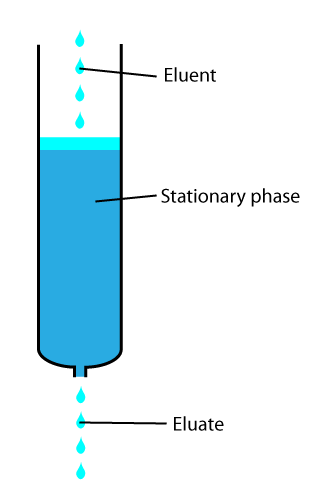
After cyclic loading molecules onto a HP20 column, the next step is to get them off again in groups of molecules with similar polarity.  We do this by passing solvents of different polarity through the column. Molecules on the column with similar polarity to that of the solvent will dissolve into the solvent and be carried out of the column and into a conical flask.  This process is called elution.   The solvent that passes through the column is the eluent. Once it emerges from the column containing dissolved molecules it is referred to as the eluate.

The first solvent used is water.  As water is quite polar and there should be few if any significantly polar molecules on the column, very little material should be removed by the water.  Its role is really just to rinse the column of any salts or very polar molecules that may have become attached.

The next solvent used is 30% acetone (30% acteone / 70% water by volume). This solvent is less polar than water and will remove moderately polar molecules from the column.  The eluate is collected in a conical flask.

Then it is the turn of 75% acetone (75% acetone / 25% water by volume). This removes a group of less polar molecules.

Finally 100% acetone gets passed through the column and removes molecules of very low polarity (and non-polar molecules).

We refer to the solutions gained as the 30% fraction, 75% fraction and 100% fraction.  Each fraction will contain a range of molecules that still need to undergo further sorting.


Thursday, 20 March 2014

Communicating Controversial Science

One of the great things about being based at Victoria University is that there are always lots of events such as lunchtime seminars that you can go along and attend. One I went to recently was called Communicating Controversial Science.  It was presented by Dr Rebecca Priestley and Dr Rhian Salmon who are both lecturers in the School of Chemical and Physical Sciences.

The seminar focused on how scientists can go about communicating 'controversial science' to the public. Just about any area of science can become controversial, but some of the examples we were looking at were fluoridation of water supplies, vaccinations, climate change, nuclear energy, cloning, genetically modified food and nanotechnology.

In the seminar we divided into three groups - chemists, nanotechnologists and nuclear scientists.  Firstly each group took the perspective of members of the public concerned about one of the other two areas.  We listed concerns that people might have.  For example, people worried about nuclear power might have concerns about radioactive materials getting into the environment or a nuclear accident such as happened at Chernobyl. The 'specialist' groups then considered those concerns and discussed ways to communicate the relevant science to the public in order to reassure them.

Until about 2000 the main model used by scientists when communicating with the public was what is now referred to as the deficit model. This model assumed that people knew very little about the relevant science and the scientist's role was to educate them. It was thought that once people had been informed of the scientific facts, they would change their views and support the new technology or scientific theory.  However, this approach has been shown to be largely ineffective.  This is partly because it does not take into account people's existing knowledge (which may or may not be scientifically accurate), or their beliefs and personal experience.  Critically, it does not provide for people to have their say and enter into any dialogue with the scientist.

After 2000 a dialogue model of science communication became more commonly accepted.  Under this model the scientist and non-scientist engage in discussion where the non-scientist is able to voice their perspective, understandings and beliefs.  However, the scientist still views their role as one of bringing the other person around to accepting the science viewpoint.

This model has now evolved further to an engagement model.  This model recognizes that effective science communication requires a genuine respect for people's current knowledge, values, perspectives and goals. The objective is not to convince people to adopt your viewpoint, but rather to provide expert knowledge and to then accept that people will use a combination of that scientific knowledge and their own understandings and values when deciding what position they will adopt. Decisions around the application of scientific knowledge in communities are the responsibility of all members of the community.  It is the role of scientists to bring scientific evidence to the debate, but all citizens have the right to participate in the debate, to have their own viewpoint respected and to apply their own values in their decision-making.

An interesting paper about the changing nature of science communication can be found at: http://tinyurl.com/qbp4wxq

Friday, 14 March 2014

Cyclic Loading

Right, back to the business of hunting for undiscovered molecules in our red algae (seaweed).  You may remember that we have got as far as extracting a whole range of molecules which are now sitting in solution in a conical flask.  The next step is to start separating the molecules into groups.  To do this we are going to use the varying polarities of different molecules.

In class we have looked at covalent bonds having different degrees of polarity depending on the difference in electronegativity of the two atoms involved in the bond.  Some bonds are not polar at all (non-polar) while others may be only slightly polar or very polar.  We have tended to classify molecules as either non-polar or polar and left it at that. However molecules also have varying degrees of polarity.  For example, water is more polar than methanol which is more polar than acetone.  We are going to use the relative polarities of these three solvents to help us to separate our mixture of molecules.

To begin with the second extract is passed through a column filled with 'HP20'.  HP20 is comprised of small white beads of polystyrene divinylbenene.  These beads provide a very non-polar surface that molecules can attach themselves to. Molecules will do this if their polarity is closer to that of the HP20 than it is to the polarity of the solvent they are in. So molecules in the mixture that have a low polarity will come out of the moderately polar methanol solvent and attach themselves to the HP20.

Solution that passes through the column is collected in a conical flask at the bottom.  The flow rate is about one drop per second so it can be quite a slow process.  Once the second extract has passed through the column, it is the turn of the first extract which is loaded into the top of the column. Eventually both extracts have passed through the column and the solution containing all the molecules that have not attached to the column is in the conical flask at the bottom.

We now want to encourage some of the slightly more polar molecules onto the column.  To do this we need to make the solvent more polar.  This is achieved by doubling the volume of the solution by adding distilled water.  Remember that water is more polar than methanol so the solvent (now a mixture of water and methanol) is more polar than it was before. The solution is put through the column again and this time some of the slightly more polar molecules attach to the column.  This process is repeated one more time to make the solvent even more polar and to cause more molecules to attach to the column.

Molecules of high polarity will not, of course, attach to the column as they will prefer to remain in the polar solvent.  This is not a problem for us as the molecules that we are hunting for do not tend to be of high polarity.  However, just in case something important is still in the solution, we will keep it in the meantime.

Thursday, 13 March 2014

A Professor Visits

Recently I was lucky enough to attend a Tertiary Chemistry Teaching Symposium held here at Victoria University.  It was a gathering of chemistry lecturers from different universities around New Zealand and had a particular emphasis on teaching and learning in First Year chemistry courses.  The lecturers shared ideas and discussed common challenges that they were facing.  One of those challenges is that different schools cover different NCEA Level 3 chemistry achievement standards and therefore students in a First Year chemistry course can have a range of backgrounds in chemistry.  This, of course, makes it challenging to design First Year chemistry courses.  The lecturers were particularly concerned that not all students were doing the three external NCEA Level 3 chemistry standards.

Guest speaker at the symposium was Professor Roy Tasker from the University of Western Sydney where he is Professor of Chemical Education. Professor Tasker's presentation was on Visualisation of the Molecular World for a Deep Understanding of Chemistry. His key message was that to understand the chemistry that we observe (for example, a precipitate forming) we need to be able visualise what is happening at a molecular level, rather than jumping straight to writing a chemical equation.

 Professor Tasker's team are responsible for producing the VisChem videos that we sometimes watch in class.  These videos, showing animations of chemical reactions at the molecular level are now available to anybody through Scootle - tinyurl.com/VisChemOnScootle

A YouTube video on VisChem Learning Design, which demonstrates best practice in using molecular animations in the classroom can be found at: tinyurl.com/k2x34sr This approach involves students observing a chemical reaction, recording their observations and then producing a storyboard to show what they think is happening at the molecular level. They then discuss their storyboard with a peer before being shown the VisChem animation.  After viewing the animation students then reflect on any similarities and discrepancies between their representations and the animation. Finally what is happening at a molecular level is linked to how that can be represented by a chemical equation. This approach is a constructivist one which takes into account a student's current model of what is happening. It involves cognitive conflict as a student's previously held perceptions may be challenged by what is in the animation.   

If you are interested in seeing some amazing animations of molecules at work in living things, you might like to have a look at a video of a presentation by Drew Berry called Animations of Unseeable Biology - tinyurl.com/7tkh9zw

Monday, 24 February 2014

Extracting Molecules

After sitting in methanol for 24 hours, it was time to separate the algae from the solution.  To do this I used a Buchner flask and funnel. The flask is attached to a simple pump that lowers the pressure inside the flask and helps to pull solution through the filter paper in the funnel.  I tipped the solution into the funnel and then added the algae so as to retrieve as much solution as possible.  The solution (with the extracted molecules) ended up in the flask while the algae was trapped in the funnel.  The solution is called the first extract.

The algae was then returned to its original flask and more methanol was added to it (300 mL for the P. angustum, 500 mL for the P. microcladioides).  It was then left for another 24 hours so that more molecules could be extracted from the algae.

After 24 hours the algae was separated from the solution in the same way as above. The solution obtained this time is called the second extract.

We have now probably finished with the algae, but rather than throwing it out, the algae is placed in a bag and stored in a freezer.  This is so that it is still available in case we need to use it again later.